Campus Talk: Season 1 - Episode 1
The Premiere Episode
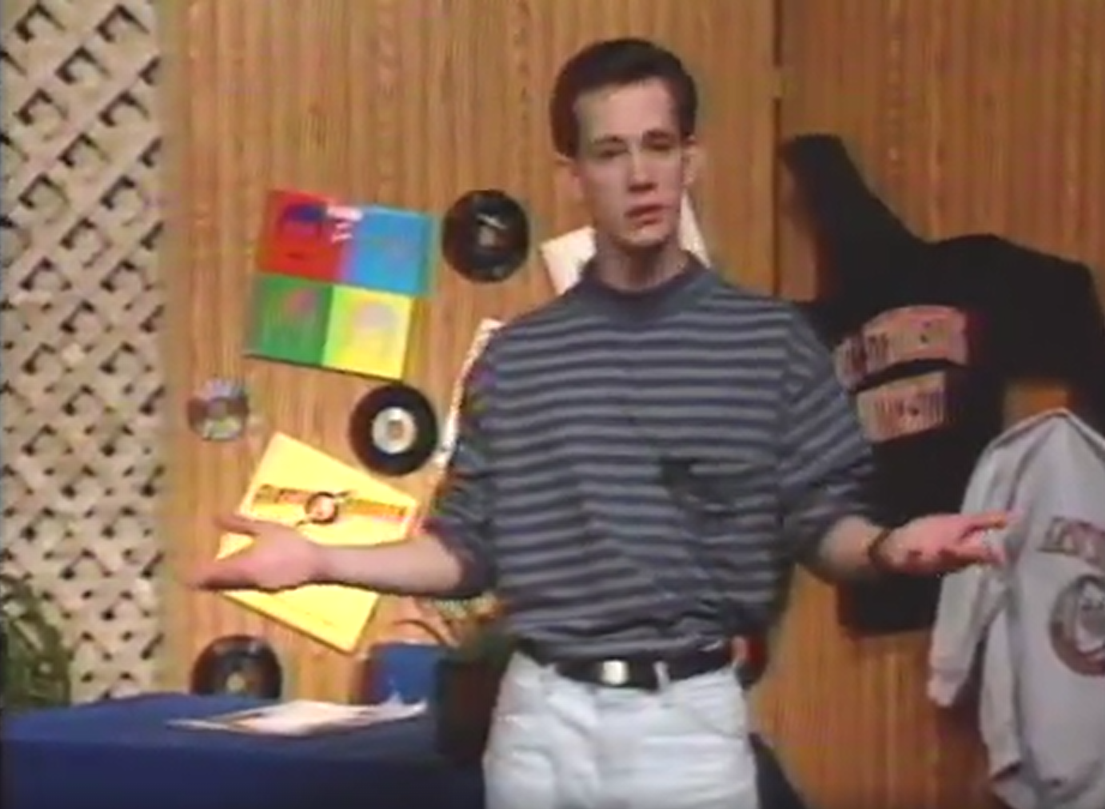
About This Production
In the premiere episode of Campus Talk, David Thompson and co-host Colin share news from around East Stroudsburg University before speaking with Professor Charles Warner about race, cultural influence, rock and roll, and reggae. The show then welcomes golf team members Tom Mowatt and Scott Alexander to discuss spring-break training, balancing athletics with academics, golf etiquette, and advice for beginning players.
Watch Campus Talk: Season 1 - Episode 1
Synopsis
David Thompson and co-host Colin open the first episode of Campus Talk by introducing the program as a look at the students, faculty, and activities of East Stroudsburg University. They begin with campus announcements, including upcoming trips, yearbook sales, opportunities with ESU News, and recognition of the Warriors’ recent athletic success.
The first guest is Professor Charles Warner of the Speech Department, who discusses his contribution to a forthcoming collection about twentieth-century American popular music. His essay examines the role and representation of African Americans in the development of rock and roll. The conversation explores the Black musical foundations of rock, Elvis Presley’s role in bringing the form to a mass white audience, and the complicated relationship between cultural influence, commercial success, and appropriation. Warner and Thompson also discuss artists including Vanilla Ice and 3rd Bass and the different ways white performers have entered traditionally Black musical forms.
Warner then describes his doctoral research into reggae and its limited success as mainstream popular music in the United States. The discussion covers Bob Marley, dancehall reggae, disco, Steel Pulse, UB40, and the historical relationship between Jamaican music and American rhythm and blues. Warner contrasts reggae’s reception in the United States with its development in Great Britain, where a large West Indian population helped create greater cultural exchange. Thompson closes the interview by thanking Warner for serving as the program’s academic adviser.
After a promotional appearance by Pulse of the Poconos host Jack Coyle, the episode returns with ESU golf team members Tom Mowatt and Scott Alexander. The graduating seniors describe the team’s upcoming spring-break training trip to North Carolina, where the players will spend several days preparing for their spring tournament season.
The golfers discuss how college and athletics both require patience, maturity, perseverance, and the ability to recover from mistakes. They also compare the dress expectations of private and public golf courses and explain why appropriate appearance remains important during tournament play. The segment concludes with practical advice for new golfers: begin with an inexpensive starter set, seek professional instruction, and learn the game on a shorter executive course.
David ends the premiere with a playful series of reminders and the sign-off, “No matter where you go, there you are.”
Cast & Credits
David Thompson: Host
Colin Fleming: Co-host
Dr. Charles Warner: Guest; professor in the ESU Speech Department and academic adviser to Campus Talk
Tom Mowatt: Guest; ESU senior, economics major, and golf team member
Scott Alexander: Guest; ESU senior, speech communications major, and golf team member
Director - Frank Kutch
Production Notes
The Tonight Show Starring Johnny Carson was a major inspiration for Campus Talk. I had grown up watching Johnny Carson, and when he left The Tonight Show, I felt the absence of that kind of late-night television almost immediately. His departure was one of the reasons I became interested in creating a talk show of my own. Campus Talk was never intended to imitate Carson directly, but the basic idea of a host sitting behind a desk, talking with guests, introducing segments, and giving the program a personality of its own came directly from my appreciation for The Tonight Show. Even the “More To Come” bumpers used when returning from commercial breaks were inspired by the way The Tonight Show handled its own transitions between segments.
I wrote the original series treatment and proposal for Campus Talk in a single night and presented it the following day to the Director of the McGarry Communications Center. After reviewing the treatment and proposal, the Director approved Campus Talk and gave me permission to use the television studio and editing facilities to produce the show. There were only two conditions: the production would have no budget, and I would need to find a faculty member willing to serve as the show’s advisor. Dr. Charles Warner of the Speech Department agreed to take on that role. He also became the first faculty member I interviewed in Season 1, Episode 1. In the recorded opening of each episode, Dr. Warner can be seen wearing a headset and giving the cue at the end of the introduction.
Because Campus Talk had no production budget, virtually everything used to create the set came from materials that were already available in the Communications Center. I incorporated set pieces that had been built for other productions and brought in some of my own materials to give the set more personality. The couch used for guests was actually taken from the waiting area in the hallway outside the Communications Center, while the host desk was a studio production desk that was repurposed for the show.
The crew for each episode consisted primarily of university students who worked in the Communications Center. Depending on their availability, students served as camera operators, floor manager, director, technical director, and audio director. Because everyone also had class schedules to work around, the size of the crew could vary considerably from episode to episode. On some production days, we worked with as few as two camera operators, a director, and an audio director.
Each episode was recorded live onto 3/4-inch videotape and then edited onto a final master tape. I used a Macintosh computer to create the “More To Come” bumpers used between segments, while the scrolling closing credits were produced with the Communications Center’s character generator.
All 13 episodes of Campus Talk were ultimately broadcast on the Blue Ridge Cable Public Access channel during 1992 and 1993, making the program available to cable subscribers throughout the channel’s viewing area. What began as a proposal written in a single night became an actual television series that was produced, edited, and broadcast to the public.
Years later, Frank Kutch was kind enough to transfer all 13 episodes from their original 3/4-inch master tapes to DVD. Those transfers preserved the complete run of Campus Talk and are the source from which the surviving episodes can now be viewed.
That second-to-last paragraph is the part I especially like. “What began as a proposal written in a single night became an actual television series…” ties the whole story together—from writing the proposal, to getting approval, to putting together a no-budget studio production, to all 13 episodes actually airing. Thank you Johnny Carson!